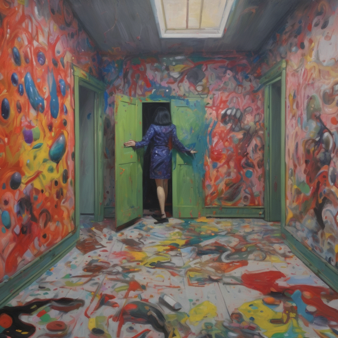
Many highly intelligent, analytically sharp people are uncomfortable with the idea of play. The word itself can feel faintly embarrassing, often associated with ‘wasting time’ or self-indulgence. Doing something with no measurable output, no goal, no justification, tends to produce anxiety more than relief.
Nadja Rolli is a child psychotherapist and author who has spent her career working with play as a clinical and developmental tool. She walks through a five-stage model of play development, sensory, attachment, constructive, fantasy, and competitive, and what becomes clear is that many adults, particularly high-functioning ones, were pushed into achievement-oriented, competitive modes long before the earlier stages were properly lived through. The things that follow from that, needing to justify rest, struggling to lose without it feeling like something larger, being uncomfortable with open-ended unproductive time, are not personality quirks. They have a developmental logic.
We also get into how play connects to trauma repair, what attachment play looks like across a lifetime, why some people genuinely do not know what they enjoy anymore and what that points to, the historical reasons play came to be seen as dangerous or morally suspect, and what gets lost developmentally when children are moved too quickly into screens.
The question underneath is, truly, whether you have ever genuinely felt entitled to exist outside of what you produce, and what it would mean to recover that.
Nadja Rolli is a child and adolescent psychotherapist based in London and the author of Can We Play Now?
TIMESTAMP
- 00:00 — Why play feels foreign to intellectually oriented adults
- 04:34 — The difficulty of defining play, and why it resists a single definition
- 05:43 — Introducing the five-stage developmental model
- 06:13 — Competitive play: rules, measurement, and the structure of winning and losing
- 07:42 — Sensory play: embodiment, stimulation, and meaning-making before language
- 10:31 — Productivity guilt: what happens when high-achievers encounter unstructured space
- 15:15 — The deeper question beneath “I am not allowed to self-indulge”
- 17:06 — The historical suppression of play: the church, moral productivity, and the splitting of play into acceptable and dangerous forms
- 18:53 — Play, mess, and the anxiety of losing control
- 22:43 — Winnicott on play as the space between internal and external worlds
- 29:49 — On needing to justify play, and why that justification has its limits
- 31:13 — Play and trauma repair: which neural pathways are involved and why
- 35:17 — When competitive play collapses under frustration: developmental gaps and resilience
- 39:36 — Attachment play from infancy to adult intimacy
- 40:14 — Hide and seek as clinical material: a case study in attachment rupture and repair
- 44:35 — Constructive play, belonging, and adolescent identity formation
- 46:55 — Fantasy play: self-worth, resilience, and the rehearsal of a larger self
- 51:46 — Technology and gaming: reward systems, developmental timing, and what gets skipped
- 57:28 — Playfulness as a relational capacity in long-term partnerships
- 01:01:59 — “I do not know what I like”: play, self-knowledge, and what it takes to recover both
About Nadja:
Nadja Rolli is an integrative Child and Adolescent Psychotherapist and published author with over 20 years of experience working in schools, local authority settings, and private practice in Brook Green, Shepherds Bush. Originally from Switzerland, her work draws on somatic experiencing, Jungian symbolism, play therapy, and EMDR to support children, young people, and adults in healing from attachment wounds and trauma. She is a UKCP and BACP registered member and holds EMDR Europe accreditation.
To find Nadja: https://www.passt.co.uk
The book: https://www.karnacbooks.com/product/can-we-play-now/98442/

Imi Lo is a psychotherapist and consultant who has dedicated her career to helping emotionally and intellectually intense people turn their depth into strength. She has written three books with Hachette: Emotional Sensitivity and Intensity, The Gift of Intensity, and The Gift of Empathy.
Imi has over fifteen years of clinical experience, including roles with Médecins Sans Frontières and the NHS (UK), and holds three master's degrees in Mental Health, Buddhist Studies, and Global Cultures. Her training includes art therapy, philosophical counselling, Jungian psychology, mentalization-based treatment, EMDR, Schema Therapy, mindfulness-based and trauma-informed modalities, and she works integratively with psychodynamic, philosophical, and creative methods.
You can contact Imi for a one-to-one session tailored to your specific needs.